













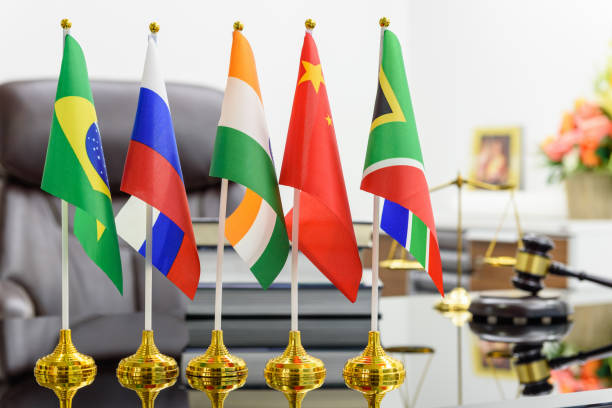
BRICS economy and policies concept : Flags of BRICS or group of five major emerging national economy i.e Brazil, Russia, India, China, South Africa. BRICS members are all leading developing countries.
Emerging markets have faced heavy headwinds in recent months as the U.S. rolled out a new wave of tariffs — with Chinese goods facing duties of up to 35% and India and Brazil hit with levies as high as 50%. On the surface, such protectionist measures should weigh heavily on export-driven economies. Yet, many emerging markets are proving more resilient than expected.
Carlos Hardenberg, investment manager at MCP Emerging Markets LLP, believes that “despite the current wave of global protectionism and escalating trade tariffs, emerging markets continue to offer compelling investment opportunities.” His optimism rests on two pillars: robust domestic demand and growing trade diversification.
India: Consumption Powerhouse
India’s vast internal market offers a natural buffer against external shocks. With over 1.4 billion people and private consumption worth $2.1 trillion in 2023, India’s economy is powered more by households than exports. This makes it less vulnerable to tariff-related disruptions.
By 2030, India is set to become the world’s second-largest consumer market, with 773 million active consumers — up sharply from 529 million in 2024. The trend is already visible: luxury car sales have risen 35% annually since 2019, while ultra-luxury home sales surged 50% in 2023.
Structural drivers add to this momentum. A young population, rising incomes, and rapid urbanisation are fueling demand for premium goods and services. Upcoming policy reforms could also accelerate this growth. Prime Minister Narendra Modi’s “next generation GST reforms,” slated for October 2025, aim to simplify India’s indirect tax system. Hardenberg expects this to lift sectors like autos, cement, apparel, footwear, insurance, and affordable hotels.
Brazil: Diversification as a Shield
Brazil, too, demonstrates how trade diversification can mitigate tariff risks. While U.S. duties have been steep, their impact is limited. Only 12% of Brazilian exports go to the U.S., and Capital Economics estimates that even a blanket 50% tariff would trim GDP by just 0.3–0.5% over three years.
Investor sentiment remains strong. The real has gained 10% against the dollar this year, while Brazil’s BOVESPA index is up 14%. Much of this resilience comes from deepening trade ties within the BRICS group — particularly with China and India.
History provides a useful precedent. During the 2018 U.S.–China trade war, China sharply increased soybean purchases from Brazil, a pattern now repeating as trade tensions flare once again. Beyond BRICS, Brazil also benefits from a shift toward South-South trade.
ASEAN and Beyond
Trade resilience isn’t limited to the big players. Within Southeast Asia, intra-ASEAN trade reached 21.5% of the bloc’s total commerce in 2024, valued at $3.5 trillion. This growing regional integration further reduces reliance on Western markets and cushions against external shocks.
Conclusion: Focus on Structural Strengths
In an era of heightened protectionism, Hardenberg argues that investors should “look beyond export data and instead focus on the structural strengths of emerging markets.” Large populations, rising consumption, and diversified trade relationships position economies like India and Brazil to remain resilient even against higher tariffs.
For investors, the message is clear: despite short-term turbulence from tariffs, the long-term story of emerging markets remains one of growth, opportunity, and resilience.
Related posts


NEW YORK, NEW YORK - JANUARY 28: The New York Stock Exchange (NYSE) stands in the Financial District in Manhattan on January 28, 2021 in New York City. Markets continue a volatile streak with the Dow Jones Industrial Average rising over 500 points in morning trading following yesterdays losses. Shares of the video game retailer GameStop plunged. Spencer Platt/Getty Images/AFP